May 16, 2026 • Dale Kosmicki • 9 min reading time • Prices verified May 24, 2026
Cordless Angle Grinders: Battery Platform Lock-In, Runtime Math, and the Real Cost Per Cut
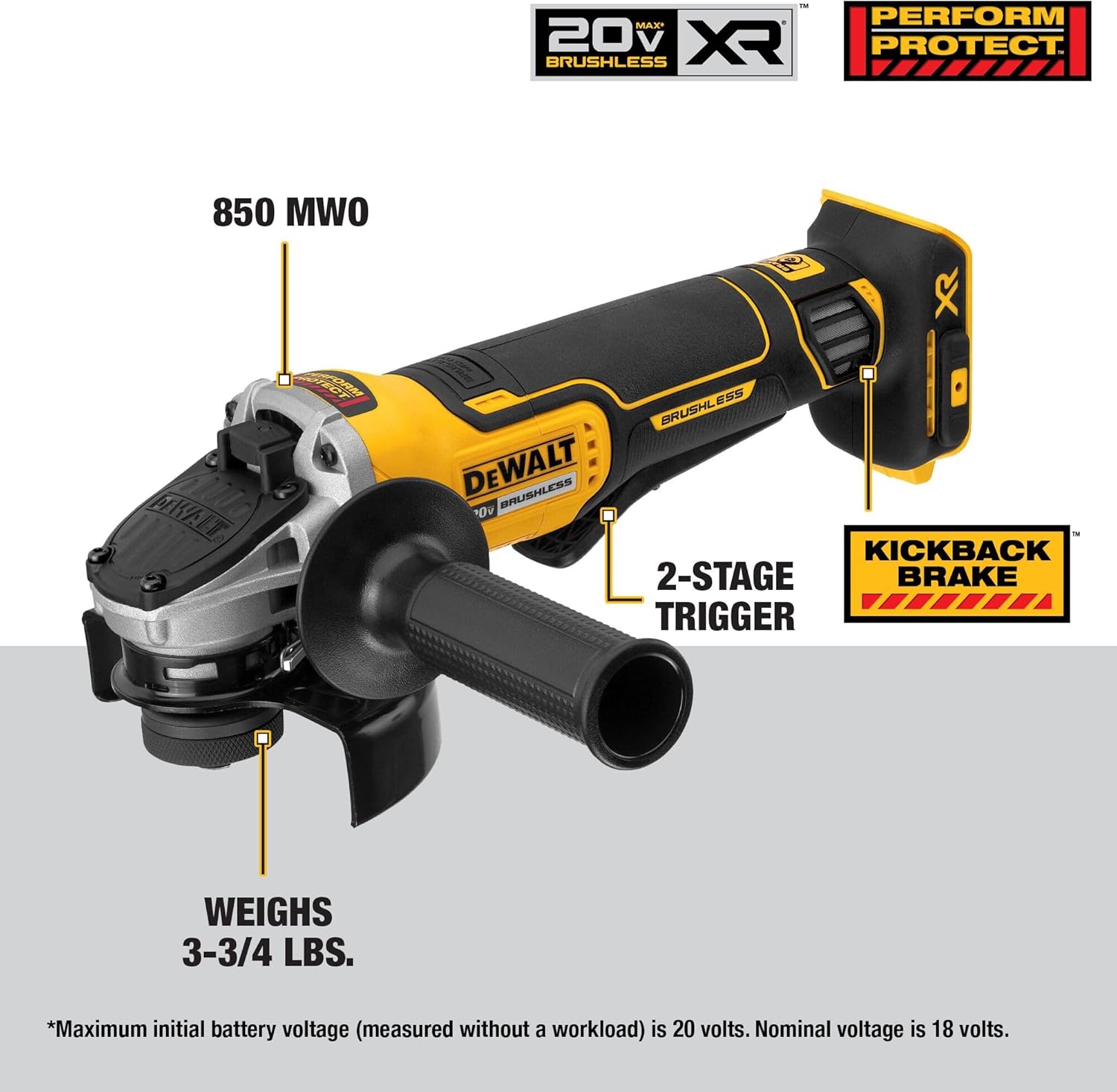
An angle grinder is one of the most common power tools in any metal shop — it spins an abrasive disc (a grinding wheel or cut-off wheel) at high speed to cut, grind, or finish metal surfaces. For most of the last 40 years, you plugged them in. The cord limited where you could work, but it also meant unlimited run time and consistent motor power. Cordless angle grinders — battery-powered versions that run on rechargeable lithium-ion packs — have gotten genuinely capable in the past five years, and a lot of shops are eyeing the switch. This guide is for anyone about to make that call: you’ll understand what battery “platform lock-in” means for your tool budget, how to run the runtime math before you buy, and how to figure out whether cordless actually pencils out for your workflow versus just feeling convenient.
| EDITOR'S PICKDEWALT 20V MAX* Angle Grinder T… | Mid-tierDEWALT FLEXVOLT ADVANTAGE 20V M… | Budget pickMakita XAG04Z 18V LXT® Lithium-… | |
|---|---|---|---|
| Voltage | 20V MAX | 20V MAX | 18V LXT |
| Battery platform | DEWALT 20V MAX | DEWALT 20V MAX / FLEXVOLT | Makita 18V LXT |
| Max wheel size | 4.5" | 4.5" to 5" | 4.5" / 5" |
| Switch type | Paddle | Paddle | — |
| Includes kickback brake | ✓ | — | — |
| Price | $155.95 | $138.95 | |
| See on Amazon → | See on Amazon → | See on Amazon → |
What Battery Platform Lock-In Actually Costs You
Here’s the gotcha nobody puts on the spec sheet: when you buy a cordless angle grinder, you’re not just buying a grinder. You’re buying into a battery ecosystem. Milwaukee M18, DeWalt 20V/FLEXVOLT, Makita 18V LXT, Metabo 18V — each uses a proprietary battery pack that won’t swap into a competitor’s tool. Once two or three of your shop’s cordless tools run on a single platform, switching platforms means replacing batteries across your entire cordless inventory. Batteries aren’t cheap. A 5.0 Ah (amp-hour — a measure of energy storage capacity) pack runs $80–$130 at retail in 2026, and high-capacity 8.0–12.0 Ah packs used in heavy grinding applications run $150–$250 each.
The practical consequence: the platform decision outlives the grinder. A 4½” cordless grinder might have a useful shop life of three to five years under daily use. The battery platform commitment could last a decade or more. Before you spec a grinder for a new operator station, ask which platform already dominates your shop’s cordless drill, impact wrench, and reciprocating saw population. If your crew is already 80% Milwaukee M18, buying a DeWalt FLEXVOLT grinder because it was $40 cheaper is almost certainly a mistake when you account for the battery buy-in.
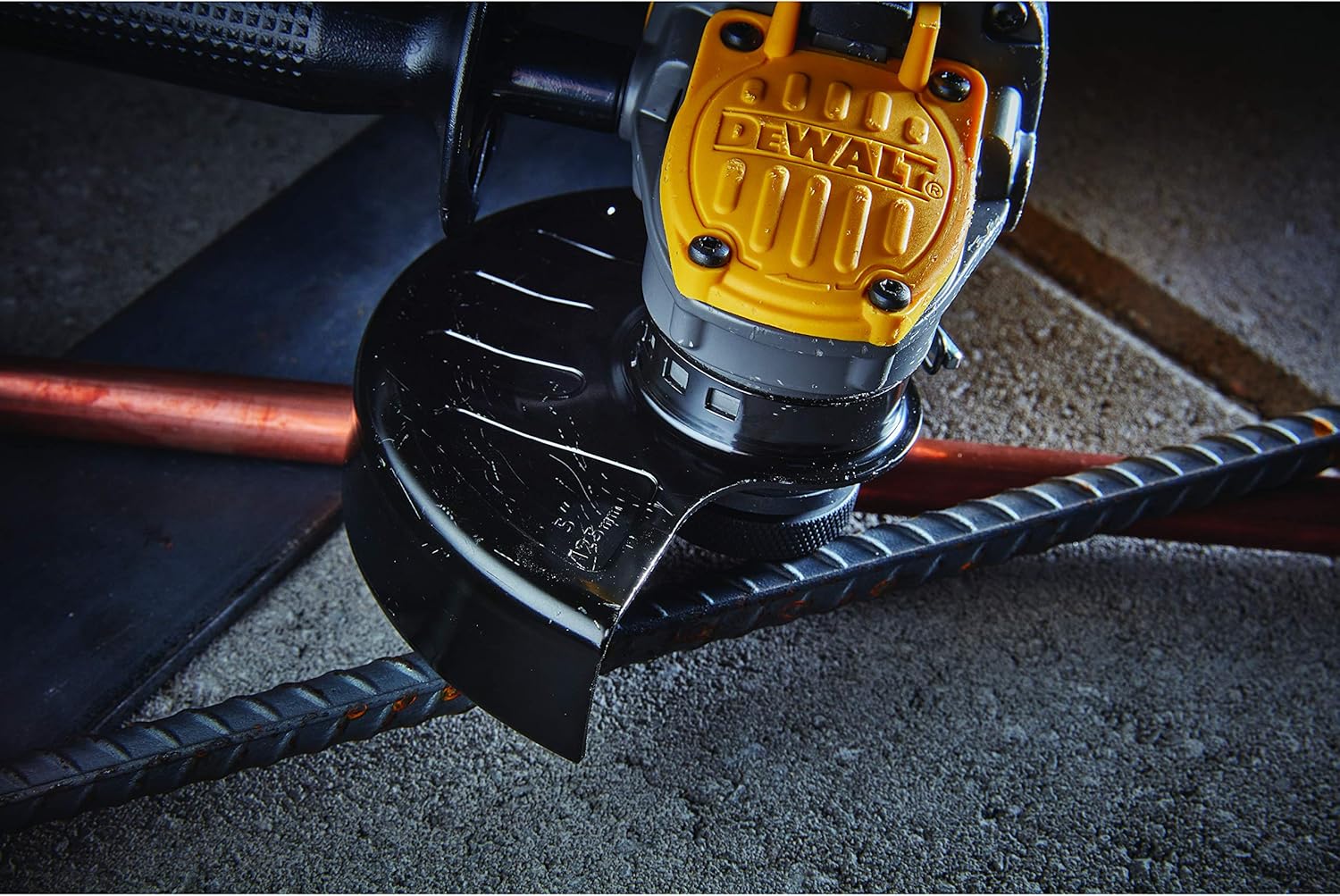
DEWALT DCG416B
$138.95
In stock on Amazon
Check price on AmazonIf your shop is starting from zero on cordless tools — or you’re outfitting a new cell — this is actually your moment of maximum leverage. Pick the platform that has the widest grinder SKU selection in the duty cycle and disc size you need, then commit.
Runtime Math: What a Battery Pack Actually Gets You
Battery runtime on an angle grinder is more complicated than the “up to X minutes per charge” claims on the box, because grinding load varies enormously. A grinder spinning a flap disc over a light surface blend barely draws current. The same grinder cutting ¼” plate with a cutoff wheel pulls near-peak amperage the entire time.
By the numbers — typical 5.0 Ah pack at 18V under real grinding load:
| Task | Approx. current draw | Estimated runtime per charge |
|---|---|---|
| Light blending / deburring | 15–20A | 12–18 min |
| Heavy weld grinding (full load) | 30–40A | 5–8 min |
| Cutting ¼” mild steel plate | 35–45A | 4–7 min |
These are ballpark figures derived from manufacturer discharge curves and independent bench tests; your mileage will vary with disc condition, operator technique, and ambient temperature. The takeaway: under production grinding conditions, a 5.0 Ah pack gives you roughly one solid cycle of heavy work before you’re reaching for a spare. This is why serious cordless grinding setups almost always run two or three battery packs per tool — one in the grinder, one or two on the charger.
Upgrade to a high-capacity 8.0 or 12.0 Ah pack and you roughly double that runtime, at the cost of meaningfully more weight (often 0.5–0.8 lb additional) and a significantly higher pack price. For overhead work or confined-space jobs where cord management is genuinely dangerous, that trade-off makes sense. For bench or floor work next to a power drop, you need to be honest with yourself about whether the convenience premium pays off.
DEWALT DCG416B
$138.95
In stock on Amazon
Check price on AmazonA mid-tier 18V 5.0 Ah setup with two battery packs and a dual-port fast charger is the standard recommendation for operators who use the grinder as a secondary tool — weld cleanup, deburring, prep work — rather than a primary production tool running multiple hours per shift.
Calculating Real Cost Per Cut
“Cost per cut” is exactly what it sounds like: how much does each grinding or cutting operation actually cost, including consumables, tool amortization, and labor time lost to battery swaps or recharging. Here’s how to build the math:
Step 1 – Disc cost per cut. A standard 4½” type 27 grinding disc (used for weld grinding) runs $1.50–$3.50 per disc depending on brand and grit, with 60–150 cuts per disc on light structural steel depending on disc quality and operator. At $2.00/disc and 80 cuts, that’s roughly $0.025 per cut in consumables. This number doesn’t change whether you’re corded or cordless.
Step 2 – Tool amortization. A quality cordless grinder body runs $100–$180 in 2026 (tool-only pricing). At 500 hours of life under moderate shop use, and assuming you average 20 cuts per hour, that’s 10,000 cuts — tool body amortization of $0.01–$0.018 per cut. A comparable corded grinder at $80–$120 runs longer (fewer wear points) and amortizes slightly cheaper. The delta is small.
Step 3 – Battery amortization. This is where cordless loses ground. Two 5.0 Ah battery packs at $100 each = $200. Lithium-ion packs in grinding service typically deliver 300–500 charge cycles before capacity drops meaningfully. If you’re running one to two full cycles per shift, those packs last 18–36 months. Amortized over 10,000 cuts, you’re adding $0.02 per cut in battery cost alone. That’s a 25–40% increase in tool-related cost per cut compared to corded. Over a production run of 100,000 cuts per year, that’s roughly $2,000 in additional annual cost — not devastating, but not invisible either.
Step 4 – Labor and downtime cost. At $30/hr loaded labor, a 3-minute battery swap-and-charge wait costs $1.50. If your operator hits a dead battery twice per shift, that’s $3/shift in labor drag — around $750/year for a five-day shop. This cost evaporates if you run enough spare packs to keep an operator continuously busy, but that pushes your battery inventory cost up proportionally.
For most shops, the honest answer is: cordless is cost-neutral to slightly more expensive per cut than corded. You pay a premium for the mobility, and that premium is real but modest if you manage your battery inventory correctly. Where cordless clearly wins on TCO (total cost of ownership) is when cord management is actively creating rework, safety risk, or workflow bottlenecks — confined spaces, overhead work, mobile fab units, or multi-level structural work where running extension cords is a genuine hazard.
DEWALT DCG413B
$155.95
In stock on Amazon
Check price on AmazonFor fabricators running cordless as a primary production tool across multiple shifts, the professional tier — larger battery platform with 8.0+ Ah packs and a multi-bay rapid charger — is the only setup where downtime cost stays controlled. Skimping on battery inventory to save upfront cost is where shops get burned.
OSHA and ANSI Compliance Don’t Change When You Go Cordless
This deserves its own section because it gets glossed over. OSHA 1910.215 governs abrasive wheel machinery, and its requirements — maximum operating speed ratings, guard requirements, ring-testing procedures for bonded wheels — apply regardless of whether your grinder is corded or cordless. Similarly, ANSI B7.1 (Safety Requirements for the Use, Care and Protection of Abrasive Wheels, published by the American National Standards Institute) sets the standards that wheel manufacturers certify against. If you need to reference or purchase ANSI B7.1 directly, contact ANSI through their official channels or request the document through your industry safety officer or distributor.
The practical implication: don’t assume that because a grinder is battery-powered, the no-load RPM rating drops into a different risk category. Many cordless 4½” grinders run at 9,000–11,000 RPM no-load — identical to corded units. The wheels still need to be rated at or above the grinder’s max RPM. Guards still need to be in place and properly adjusted. Angle grinder injuries remain among the most common shop injuries in metal fabrication, and guard removal is a leading contributing factor — a pattern well-documented across trade safety resources including The Fabricator. Cordless tools don’t get a pass on that.
DEWALT DCG416B
$138.95
In stock on Amazon
Check price on AmazonOne note for budget-tier buyers: some lower-priced cordless grinders sacrifice the spindle lock and guard adjustability that make wheel changes and guard positioning genuinely practical. On a high-use station, those omissions create real compliance friction. Factor it into the spec, not just the price tag.
The “If X, Then Y” Decision Framework
If you’ve read this far, you’re probably sitting on a buying decision. Here’s the clean version:
If your work is primarily stationary (bench, floor-level, or fixed workholding) and you have reliable power drops within 10 feet of your grinding stations — buy corded. You’ll get better duty cycle, lower TCO, and fewer operational headaches. The cord is not the problem people think it is when your shop is laid out correctly.
If your work involves frequent position changes, overhead passes, confined spaces, or mobile fab rigs — cordless makes operational sense. Budget for at least two battery packs per grinder and a fast charger. Don’t buy into a platform your shop doesn’t already use unless you’re committing to it wholesale.
If you’re outfitting a crew of three or more — platform consistency matters more than any individual grinder feature. Pick the platform with the best service network in your area and standardize. Industrial distributors such as MSC Industrial Direct can help you identify platform availability for your region and negotiate volume pricing on battery packs when you’re buying six or more units at once. Contact your local branch or account representative directly to discuss current inventory and fleet pricing options.
If you’re doing occasional weld cleanup or deburring as a secondary task — the budget tier is genuinely fine. You don’t need a 9.0 Ah pack for 20 minutes of grinding per day. Makita — Save the platform investment for tools that run hard.
If production grinding is your primary operation — cordless isn’t the right answer for the main station. Run corded on your primary grinder, cordless on your secondary or detail work tool, and let each platform do what it does best.
The cordless angle grinder market has matured enough that the tools are real — they’re not hobbyist toys pretending to be shop equipment. But they still require disciplined battery management and honest TCO accounting. Run the math for your specific workflow before you buy, and the right answer usually becomes pretty clear.
Affiliate disclosure: This article contains product markers linked to affiliate programs. We earn a small commission if you purchase through those links, at no additional cost to you. Our editorial recommendations are based on specs, real-world shop use, and cost-of-ownership analysis — not commission rates.