May 16, 2026 • Dale Kosmicki • 9 min reading time • Prices verified May 24, 2026
Corded 4-1/2\" Angle Grinders: Amp Draw, Duty Cycle, and Which Ones Actually Hold Up on a Production Floor
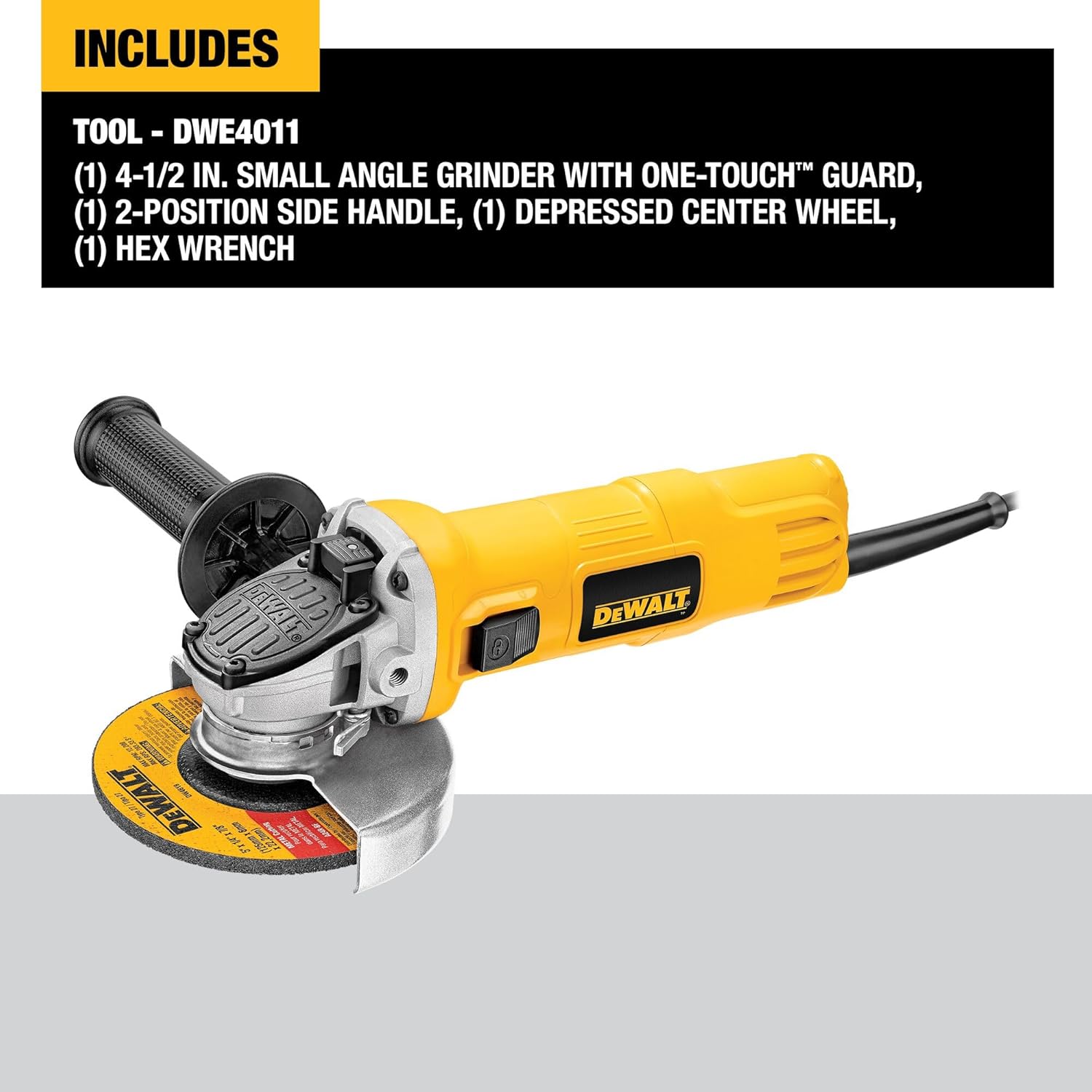
A 4-1/2” angle grinder is a handheld power tool that spins an abrasive disc — usually at 10,000 to 12,000 RPM — to grind, cut, or finish metal. You’ve almost certainly seen one on any fabrication or welding floor. The challenge is that not every angle grinder is built for the same workload. A grinder that’s perfectly comfortable for an hour of weld cleanup can overheat and shut down — or fail outright — when you put it through six hours of continuous production use. Two numbers tell most of that story before you buy: amp draw (how much electrical current the motor pulls, which translates directly to power and heat) and duty cycle (the percentage of any given time window the tool can run before it needs to cool down). Get those two right for your application, and you’re most of the way to a good decision. Get them wrong, and you’re buying the same grinder twice inside a year.
This guide walks through what amp draw and duty cycle actually mean in practice, how to use them to sort the crowded 4-1/2” corded market, and which tier of grinder makes sense depending on whether your crew runs one grinder occasionally or a bank of them all day.
| EDITOR'S PICKMakita 9557PBX1 4-1/2" Paddle S… | Mid-tierPORTER-CABLE Angle Grinder Tool | Budget pickWEN 7-Amp Angle Grinder with 4-… | |
|---|---|---|---|
| Amperage | — | 7.5 | 7 |
| Case | ✓ | — | ✗ |
| Switch type | Paddle | — | — |
| Reversible handle | — | — | ✓ |
| Price | $109.00 | $67.57 | $25.78 |
| See on Amazon → | See on Amazon → | See on Amazon → |
Amp Draw: What That Number Is Really Telling You
The amp draw rating on a corded grinder is the motor’s steady-state current consumption under load. Higher amps generally mean a more powerful motor capable of maintaining disc speed when the operator bears down — which is exactly what happens on a production floor where people are paid to move fast, not baby their tools.
The 4-1/2” corded market clusters into three bands:
By the numbers:
- 6–7 amps: Light-duty / hobbyist class — adequate for occasional cleanup, not for sustained pressure
- 7.5–9 amps: Mid-range workhorse — covers most fab shop weld prep and grinding tasks
- 11–13 amps: Heavy-duty production class — used where disc stall or motor bog would create a safety hazard or throughput bottleneck
That last point is worth pausing on. A motor that bogs under load doesn’t just slow you down — it creates heat, shortens brush life, and in the worst case can cause disc stall, which is a direct concern under OSHA 29 CFR 1910.215, the federal standard governing abrasive wheel machinery. OSHA 1910.215 mandates proper guarding and RPM-compatible wheel matching, but the enforcement reality is that undersized motors are a root cause of wheel grabs that guarding alone can’t fix.
One nuance: amp draw ratings are manufacturer self-reported under unloaded or lightly loaded conditions. Real-world loaded amperage is typically 15–25% higher. A grinder rated at 9 amps is probably pulling 10.5–11 amps when your operator is leaning into a weld bead. This matters for circuit loading when you have multiple grinders on the same 20-amp branch circuit — a common shop floor scenario that trips breakers mid-shift and costs you more in irritation than the grinders ever cost in purchase price.
Duty Cycle: The Number Most Buyers Skip
Duty cycle is expressed as a percentage: a 50% duty cycle means the tool can run for 30 minutes out of every hour before it needs a rest. A 100% duty cycle (or S1 rating in IEC motor classification) means continuous operation with no mandatory rest interval — that’s the category you want for production use.
Here’s where a lot of purchasing decisions go sideways. Grinders in the 6–9 amp range are often rated at 20–50% duty cycle. For a one-person shop doing intermittent grinding, that’s fine — the natural rhythm of pick up the grinder, grind a bit, set it down, reposition your work provides built-in cooling. On a production line where an operator is running the grinder almost continuously for 45-minute stretches, a 40% duty cycle grinder will thermally cut out, and repeatedly forcing it through thermal resets burns up brushes and degrades armature insulation faster than normal wear.
The jump to 100% or near-100% duty cycle correlates strongly with:
- Higher amp motors (11+)
- Metal gear housings vs. composite
- Sealed or protected bearings
- Carbon brush accessibility for in-field replacement
That last point — field-serviceability — is underrated in purchasing conversations. A grinder with a user-replaceable brush set and an accessible armature isn’t just more durable; it means your tool-room manager can do an annual brush replacement instead of sending the grinder out for repair or buying a new one. According to MSC Industrial’s abrasive and power tool catalog (MSC Industrial Direct, print and online editions), OEM replacement brush sets for common 4-1/2” grinders typically run $8–$18 per set — a figure that changes the total cost of ownership math considerably when you’re running five grinders across a shift.
The Tier Decision: Who Actually Needs What
Here’s the honest breakdown for the three buyer profiles we see most often.
Occasional-Use Shops and Hobby Fabrication
If your grinder sees fewer than two hours of use per day and operators naturally cycle on and off it, you don’t need a 13-amp workhorse. The lower-amp, lighter-weight options in the 6–7.5 amp range are easier to handle for long periods and cheaper to replace if they get dropped or abused. For this use case, weight (most sub-7-amp 4-1/2” grinders come in under 4 lbs) matters more than motor muscle.
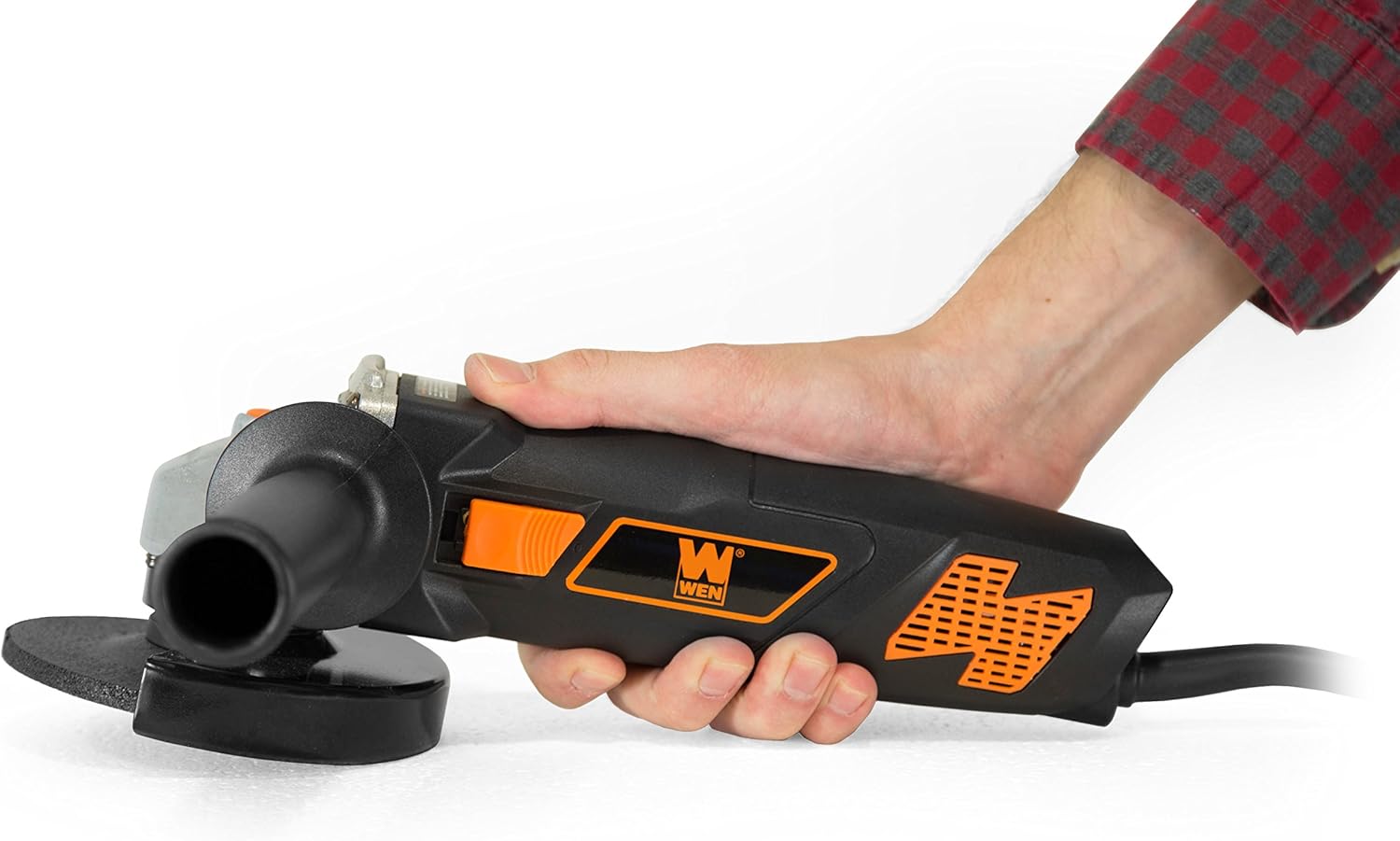
WEN 944
$25.78
In stock on Amazon
Check price on AmazonFor a small job shop where one grinder lives on the bench for the occasional cleanup pass, the budget tier does the job without overpaying for capacity you won’t use. WEN 944 — $25.78
Daily Shop Use — Single Operator or Small Crew
This is the biggest buying segment and the one with the most confusion. A fabricator doing weld prep and surface conditioning for four to six hours daily needs something in the 9–11 amp range with at least a 75% duty cycle. The practical dividing line is whether the operator ever complains about the tool shutting down mid-pass. If the answer is yes, you’ve already undersized the motor.
For daily shop work at a single station, the mid-tier 9-amp class hits a reliable sweet spot. Most carry paddle switches (preferred over lock-on triggers for OSHA compliance and kickback control), have tool-free guard adjustment, and accept both Type 27 (depressed center) and Type 1 wheels. ANSI B7.1 — the American National Standards Institute standard titled Safety Requirements for the Use, Care, and Protection of Abrasive Wheels — requires that a wheel’s speed rating always meet or exceed the tool’s no-load RPM. This is a spec that’s easier to verify when the grinder’s nameplate clearly states its RPM, which better-built mid-tier units consistently do.
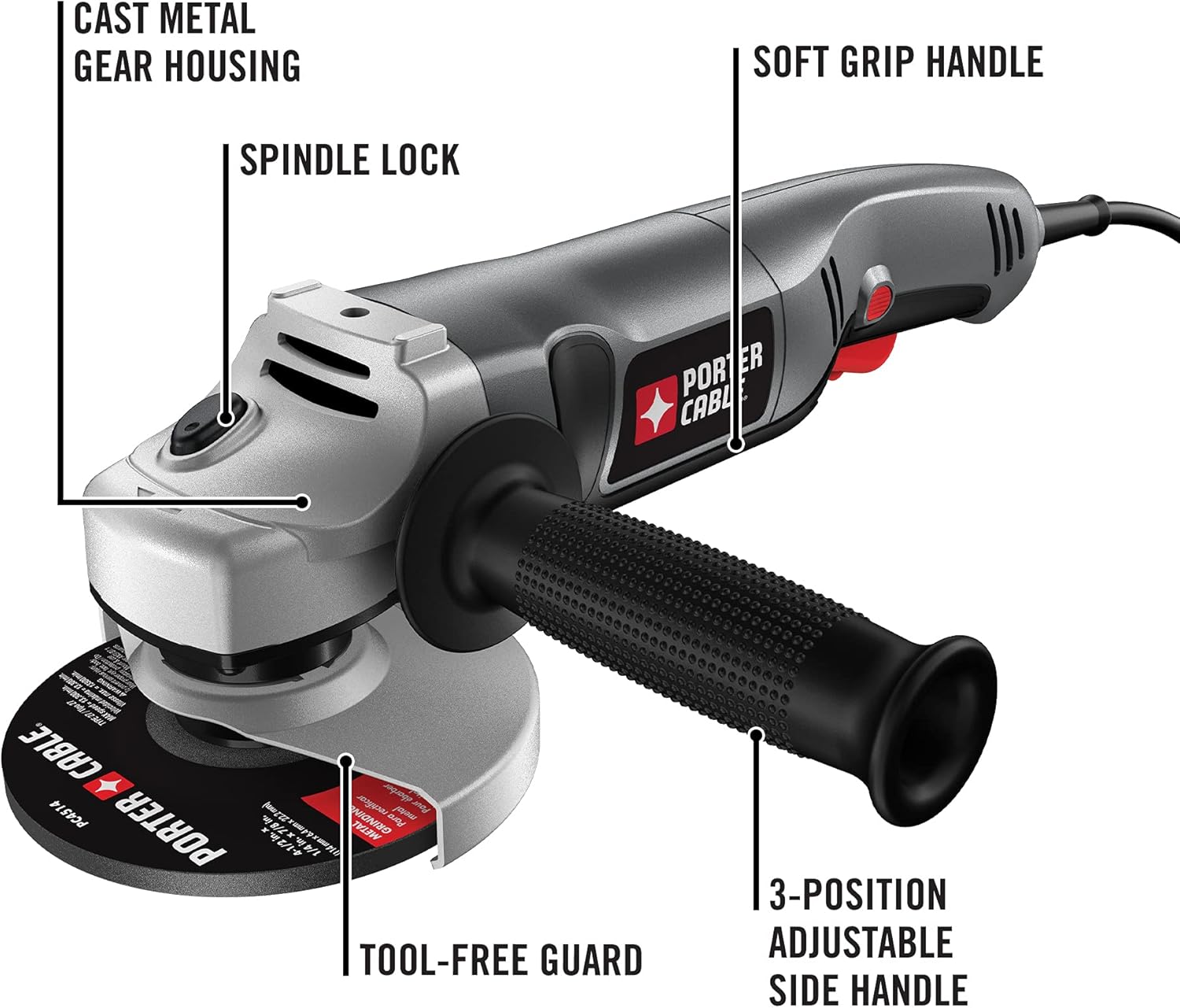
PORTER-CABLE PC750AG
$67.57
In stock on Amazon
Check price on Amazon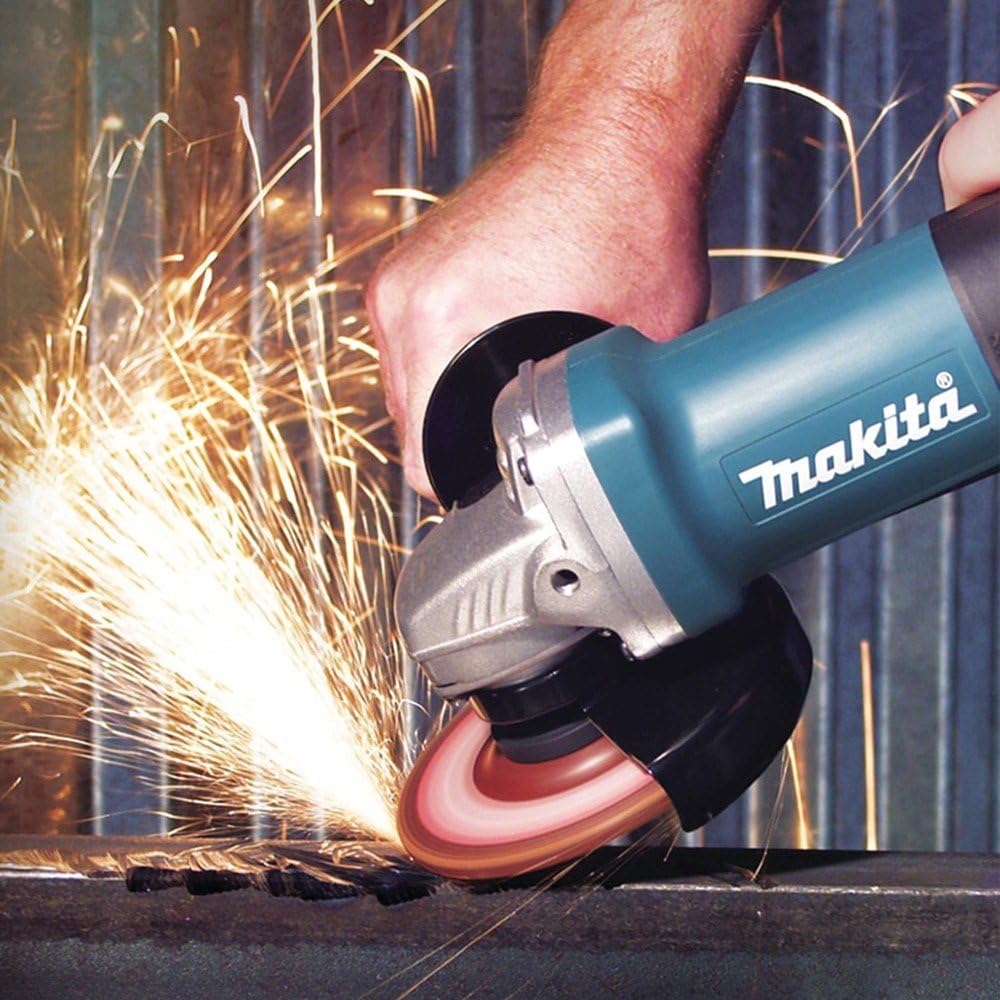
Makita
$109.00
In stock on Amazon
Check price on AmazonProduction Floors and Multi-Station Fab Operations
If you’re outfitting three or more grinding stations that run 6–8 hours a shift, the calculus changes. You’re no longer buying a grinder; you’re buying uptime. Downtime at a grinding station that’s feeding a weld cell or a fabrication line costs real money — and a $40 savings on the grinder purchase evaporates after the first thermal shutdown event causes a 20-minute disruption.
The 11–13 amp, 100% duty cycle tier is where production shops belong. These tools typically run larger armatures, sealed spindle bearings, and in some cases, electronic speed control that maintains disc speed under load (reducing the heat spike that comes from motor bog). They’re heavier — expect 5–6 lbs vs. 3.5–4 lbs for the light-duty class — but operators running sustained heavy passes prefer the additional mass for stability.
Makita
$109.00
In stock on Amazon
Check price on Amazon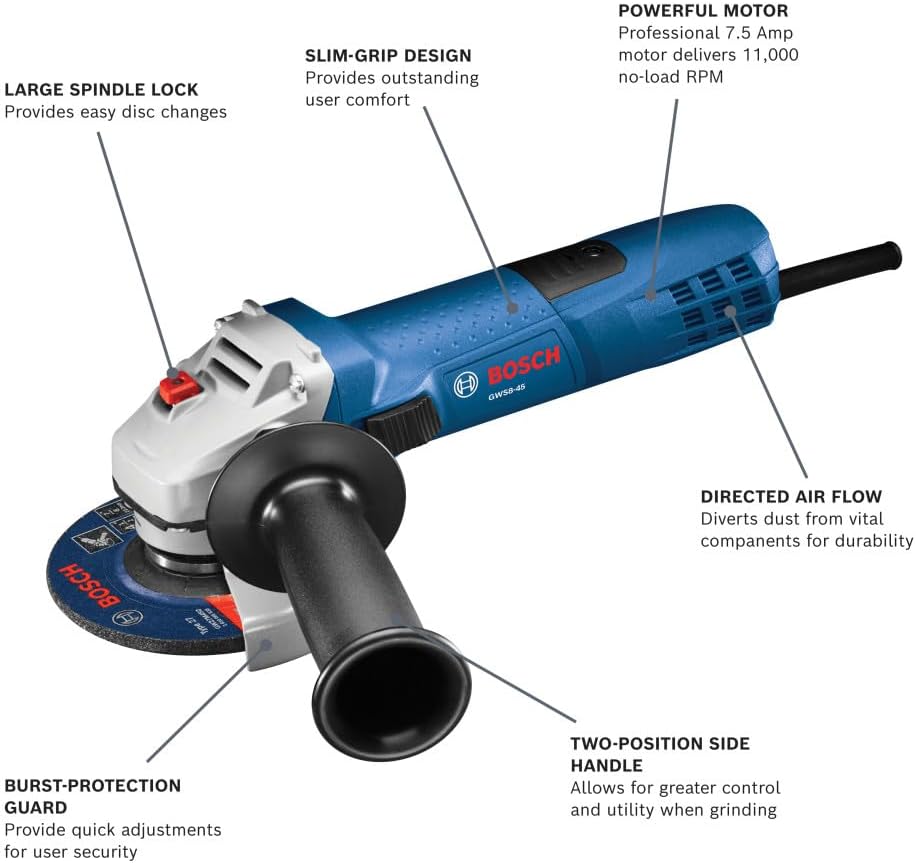
Bosch
$62.10
In stock on Amazon
Check price on AmazonFor welding prep specifically — where operators are grinding weld beads to near-flush before inspection or coating — the sustained power of a 13-amp tool with a Type 27 grinding disc makes the pass cleaner and faster than cycling through multiple passes with an undersized tool.
Makita
$109.00
In stock on Amazon
Check price on AmazonA Practical Comparison Framework
Before you finalize a purchase, run this three-question check against any grinder spec sheet:
| Question | Why It Matters |
|---|---|
| What’s the amp draw under load (not no-load)? | Determines real power and circuit loading |
| Is the duty cycle published — and is it 75%+? | Determines fit for sustained production use |
| Are brushes user-replaceable without voiding warranty? | Determines 3-year TCO vs. replace-at-failure cost |
For a multi-station purchase, add a fourth: What’s the availability of replacement parts domestically? A tool whose brushes require a 6-week overseas lead time is a procurement problem, not a tool problem. As of mid-2026, supply chain lead times on aftermarket power tool brushes have normalized for major brands but remain unpredictable for gray-market imports — worth confirming with your distributor before committing to volume.
The Safety Compliance Checklist You Should Run Regardless of Tier
No amp draw or duty cycle conversation is complete without compliance. OSHA 29 CFR 1910.215 and ANSI B7.1 set the floor for abrasive wheel use — not optional guidance, actual enforceable requirements. The compliance checklist for any 4-1/2” corded grinder on a production floor:
- Guard in place: The side guard must cover at least 180° of the wheel. Tool-free guard adjustment makes operators more likely to keep it on.
- Wheel-to-tool RPM match: The wheel’s maximum operating speed must meet or exceed the grinder’s no-load RPM, every time, no exceptions. ANSI B7.1 (Safety Requirements for the Use, Care, and Protection of Abrasive Wheels, American National Standards Institute) governs this requirement in detail.
- Ring test before mounting: Tap vitrified wheels with a light mallet — a dull thud indicates a cracked wheel. This inspection step is mandatory per ANSI B7.1.
- Personal protective equipment: Face shield over safety glasses, hearing protection above 85 dB (sustained grinding operations routinely exceed this threshold), leather gloves.
- No discs exceeding rated RPM: This is the most common field violation — operators mount whatever’s available. A grinder running 11,000 RPM mounted with a disc rated for 10,000 RPM is a disc failure event waiting to happen.
For a deeper look at how grinding operations fit into a fabrication safety program, The Fabricator publishes practical safety content aimed at shop-floor application rather than regulatory abstraction — a useful complement to the formal OSHA and ANSI language.
The Decision Rule
If you’ve read this far, here’s the clean if-then:
- If your grinder runs less than 2 hours/day and downtime is tolerable → buy the mid-range 7.5–9 amp tier, keep a spare on the shelf. Makita — $109.00
- If your grinder runs 4+ hours/day at a single station → buy the 11-amp class with published duty cycle, budget for annual brush service.
- If you’re outfitting 3+ stations or feeding a production line → buy 13-amp S1-rated tools, treat the purchase as capital equipment, and calculate consumable cost-per-cut before you choose a disc spec. Makita — $109.00
The grinder purchase is almost never the expensive part of a production grinding operation. The discs, the labor, and the downtime when the wrong tool gets put in the wrong application — that’s where the real money goes. Size the motor and duty cycle correctly up front, and the rest of that math gets a lot easier.